



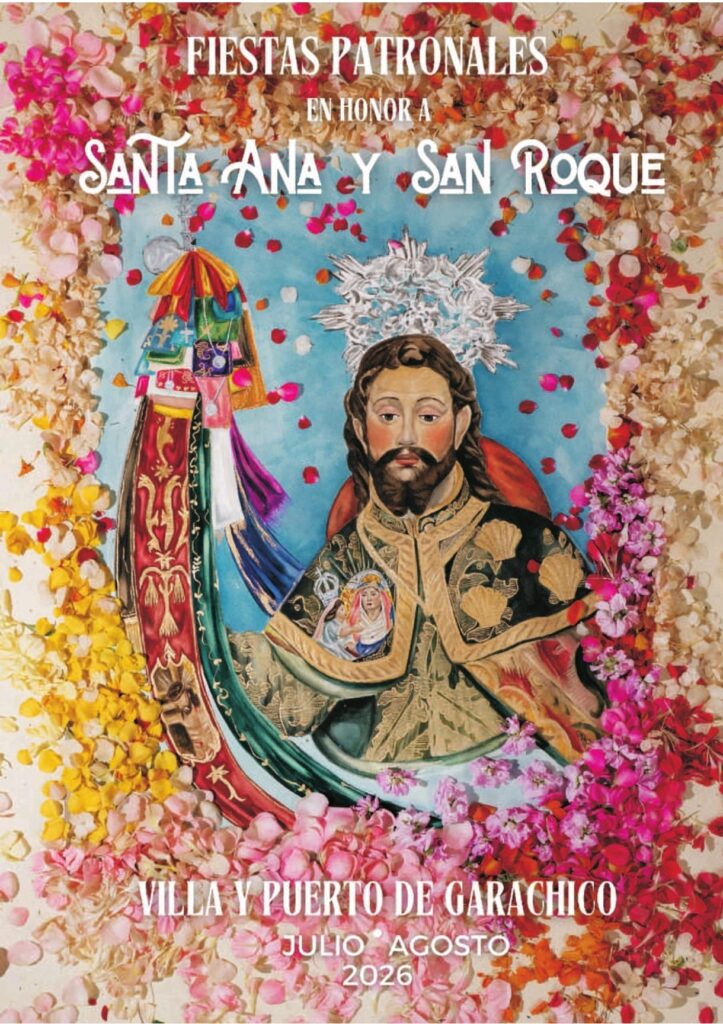
The Romería de San Roque in Garachico takes place every year on the 16th of August. It isn’t just another festival — it’s an appointment with a saint who is part of the very soul of a village.
Waking up on the 16th of August in Garachico feels different from any other day of the year. The silence that usually fills the village streets breaks with the cry of “¡Viva San Roquito!” to the beat of the Fanfarria Juvenil de Garachico. Whoever hears it for the first time, still half-asleep, doesn’t always understand what’s happening. Whoever has heard it all their life knows that the day they’ve been waiting for all year has finally arrived: the day of the Romería de San Roque.
Ask anyone from Garachico why these festivities are lived this way, and they’ll probably struggle to give you a rational answer. It’s something absorbed since birth, shared with family, friends and neighbours for as long as anyone can remember. A collective feeling of excitement that can only be understood by living it. We invite you to join the celebration and share it with us.
Devotion to San Roque
To understand the devotion Garachico holds for San Roque, we have to go back to the 17th century. Tenerife was struck by a plague epidemic, and the people of Garachico entrusted themselves to San Roque de Montpellier, patron saint of the sick and protector against epidemics. After the plague was eradicated, they attributed the miracle to him and built a chapel in his honour. Ever since, every 16th of August, they have thanked him for his intercession with a pilgrimage.
A saint the village carries on its shoulders
San Roque is not a saint observed from a distance, high on an altar. He’s the image the village carries on its shoulders every 16th of August. The one a child watches with curiosity while seeing their father or grandfather carry him with devotion, and which, over time, they will carry themselves, feeling the weight, the August heat and the sweat under the wool vest, wishing the route would never end.
Some bearers have carried the platform their whole lives: some through a family promise made to the saint, others through inheritance. All share the same pride and the same devotion.
This closeness with the saint has made him celebrated in a special and affectionate way, to the cry of “¡Viva San Roquito!”. San Roque is part of the village’s identity: that’s why he is its Patron Saint and Perpetual Mayor.
The ajijides and the ribbons of colour
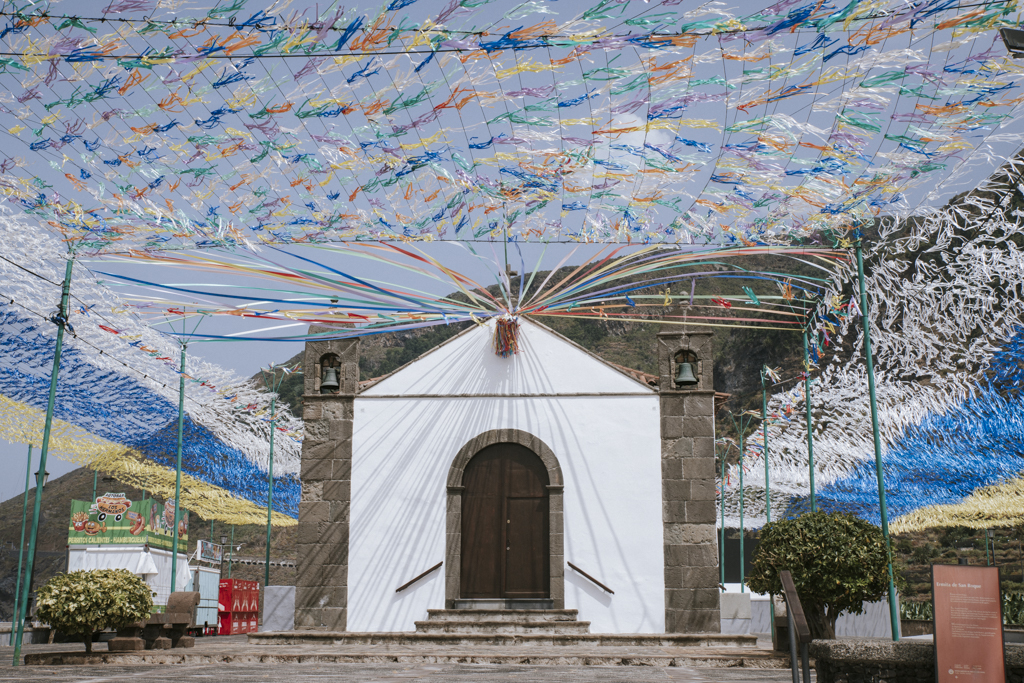
The Romería de San Roque is full of colour and has a very particular sound, to the rhythm of drums and ajijides. These are joyful shouts of pre-Hispanic origin that consist of repeating short sounds, like “ji” , to mark the rhythm of the dances or accompany traditional songs. These sounds are related to Amazigh culture and can also be heard at other religious celebrations in the Canary Islands, such as the Bajada de la Virgen in El Hierro.
The colour comes from the ribbons of promises hanging from San Roque’s pilgrim staff, given by those who have asked for his intercession and help; the cloud of flower petals that shower the saint as he passes through the streets; and the colourful garments worn by pilgrims and romeros.
It all begins long before the 16th
The Fiestas de San Roque begin at the end of July with the opening proclamation, but take to the streets on the first Saturday of August with the Romería Chica. It’s called “small” compared to the big day, but there’s nothing small about it: the streets fill with carts, wagons, folk groups and villagers dressed in traditional costume, despite the heat.
The following Friday brings the Fiesta de las Tradiciones, celebrating its 64th edition in 2026. In the Glorieta de San Francisco, right in front of the hotel, a stage is set up where folk groups from all the islands perform their repertoire of isas, folías and malagueñas, accompanied by traditional dance groups. Afterwards, the Romera Mayor is announced and a floral offering is made to San Roque, before an audience that has watched it their whole lives yet is still moved by the moment.
The next day, the Baile de Magos takes place. Plaza de la Libertad fills with tables where families and groups of friends share home-cooked dishes and Canarian wine. Everyone wears the traditional mago costume — compulsory to take part. In the Glorieta de San Francisco, in front of the hotel, the stage welcomes the orchestras that keep the party going well into the early hours. It’s a night of fun and dancing.
The Romería de San Roque
The 16th begins very early. By half past seven, the Fanfarria Juvenil is already waking the village, and from there everything unfolds in sequence. The events open with a solemn pilgrims’ mass in Plaza de San Roque. Pilgrims, the faithful and devotees then accompany San Roque to the Parroquia Matriz de Santa Ana, where another mass is held. Afterwards, the image is carried in procession to El Muelle. Each stretch has its regular crowd, people who always stand in the same spot, as if the whole village had choreographed exactly where everyone should be at every moment of the day.
At one in the afternoon, in Plaza Ramón de Arocha, the great pilgrimage begins: decorated carts, wagons, land-boats, harnessed animals and folk groups singing and dancing the whole way, accompanying the saint back to his chapel. A procession that blends the sacred with the popular, because in Garachico they have never been separate things.
San Roque arrives at his chapel amid ajijides, chants and a shower of fireworks announcing that he’s finally home. And there, at the chapel doors, comes the moment most remembered by those who have witnessed it more than once: the farewell dance, the image already in its place and the village dancing outside, as if the saint himself wanted to stay for one more round of celebration before resting until next year.
An invisible inheritance
Ask anyone in Garachico why they come back year after year, and no one will give you a short answer. It isn’t only religious devotion, although it runs deep. It isn’t only tradition, although that weighs heavily too. What really brings people back, looking closely at these days, is that this is the one time of year when the whole village, those who stayed and those who left, comes together in the same place, doing exactly what their parents and grandparents did before them.
Some have lived away from the island for twenty years and plan their entire holidays around these two weeks. They don’t come back for the beach. They come back for the half-past-seven fanfare, to reunite with the Tajaraste dancers, for the hug with someone they haven’t seen in a year and with whom the conversation picks up exactly where it left off. There’s a phrase repeated a lot around the village these days, almost like a password: “Have you come back too?” The answer is always yes.
The same happens with the children as it once happened to every adult here today. You see them running behind the carts of the Romería Chica, dressed as magos without quite knowing why yet, and you can sense that in twenty years they’ll be the ones explaining to a visitor why August in Garachico makes no sense without San Roque. Devotion isn’t explained in a conversation: it’s passed on by watching it, by living it beside someone who already carries it within.
If you’re coming this August
For anyone experiencing it for the first time, the advice given by anyone from here is always the same: arrive a few days before the Romería to soak up the atmosphere and take part in the different events with respect, to feel the devotion and joy with which the people of this village live these festivities.
Festivities that are an unmissable appointment with their most beloved and illustrious neighbour: San Roque.
Leave a Reply